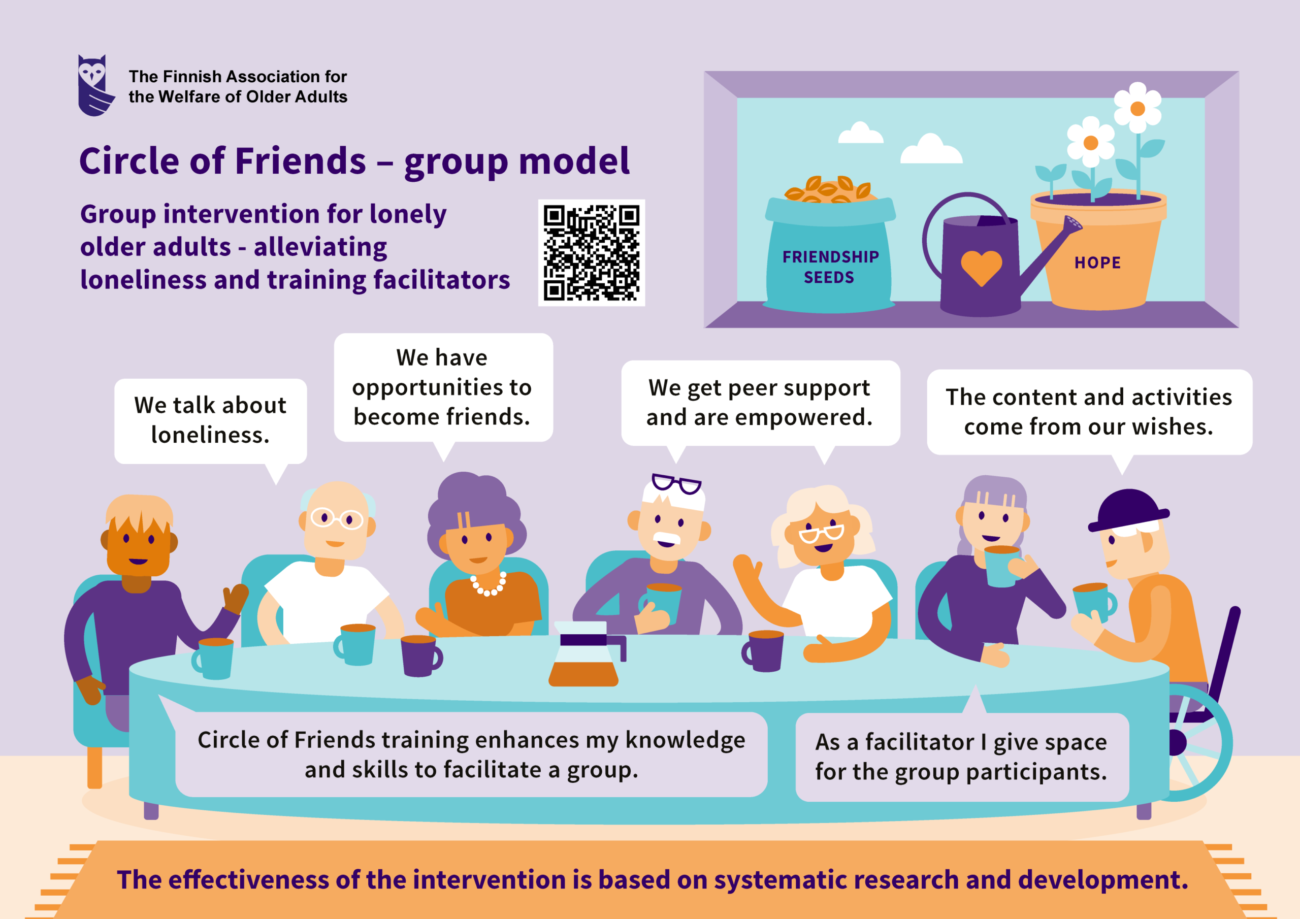
Ystäväpiiri-toiminta – Circle of Friends® (CoF) developed by the Finnish Association for the Welfare of Older Adults (VTKL), is a long-established, research-based group intervention designed to alleviate loneliness among older adults. It has been studied and refined for nearly two decades, originating in the Geriatric Rehabilitation Research and Development Project (2002–2006), which demonstrated that structured peer group activities significantly improve psychological wellbeing, memory, and overall health while reducing the use and cost of social and healthcare services. The model consists of small peer groups facilitated by trained facilitators—professionals or volunteers—who support participants in building social connections, strengthening agency, and developing lasting friendships. More than 13,000 older adults across Finland have participated in the Circle of Friends – groups, and nearly 1,300 people have completed the Circle of Friends – facilitator training provided by VTKL (VTKL 2026).
Within JA PRISM, which aims to improve mental health among vulnerable groups across Europe through preventive, rights-based approaches, the Circle of Friends -group model is one of the three evidence-based practices selected for international transfer and implementation. The project brings together partners from 20 European countries to scale up proven interventions that address loneliness, suicide prevention, and psychosocial wellbeing. The Circle of Friends – group model is implemented by training local professionals and community actors in participating countries to run the Circle of Friends – groups using the established Finnish methodology.
This includes the Circle of Friends – facilitator training, which is intended for individuals who are motivated and committed to facilitating a structured and empowering group for older adults experiencing loneliness. Participating in the training is a process that includes time‑specific tasks, outreach work, facilitating a Circle of Friends group, writing learning diaries and mentoring during the facilitator training. The process also includes adaptation to local cultural contexts while preserving core components such as peer support, closed group dynamics, and empowerment.
Through JA PRISM, the Circle of Friends – group model is being expanded beyond Finland to alleviate loneliness among older adults across Europe, contributing to the project’s broader goal of strengthening mental health promotion, prevention, and equitable access to support services.
The European Commission selected in 2024 the Circle of Friends – group model as a Best practice in its Best and Promising Practices portal on Mental Health.
For more information, please visit the website of Circle of Friends practice owners VTKL: read more about Circle of Friends – group model (opens in a new tab)
Find a video about the Circle of Friends process and training period – one model two pathways to alleviate loneliness here: YouTube video VTKL The Circle of Friends