
Work Package 5

Transfer of
BIZI Practice

Suicide prevention

The BIZI Programme

The BIZI Programme is an innovative, evidence‑informed gatekeeper training (GTK) initiative designed to strengthen suicide prevention capacity in community settings. It is an interactive, online, self‑managed and freely accessible course that equips non‑health professionals and community volunteers with the core competencies needed to identify people at risk of suicide, provide initial support, and encourage referral to specialised services. BIZI was developed by the Basque Health Service (Osakidetza) and the Public Health Directorate of the Basque Government, based on a comprehensive review of scientific evidence and on earlier face‑to‑face GTK experiences.

The programme responds to a clear public health need: although early identification and psychosocial intervention can prevent suicide, only a small proportion of people who die by suicide have contacted specialised services beforehand, largely due to stigma and lack of knowledge. BIZI directly addresses this gap by providing accessible training to “gatekeepers”—professionals such as social workers, educators, pharmacists, police officers, volunteers and others who are in daily contact with vulnerable groups.

The European Commission selected in 2024 BIZI programme as a Promising practice in its Best and Promising Practices portal on Mental Health.
Lead

Institute for Health Systems Research Biosistemak (BS), Basque Country, Spain

Co-lead

Ethnikos Organismos Dimosias Ygeias (EODY), Greece

Countries with BIZI implementation sites

The role of WP5 within JA PRISM

WP5 plays a central role in PRISM by supporting the practical implementation of the BIZI programme across different health and community settings. Its focus is to make sure that the programme can be applied effectively in real‑world contexts, recognising that evidence alone is not enough: organisations, systems and local conditions vary, and this requires planning, support and continuous follow‑up.

Its contribution to PRISM includes:

  • Supporting sites in preparing and running their pilots, clarifying what they need and helping ensure that BIZI can be implemented in different contexts.
  • Working closely with WP3 and WP4, aligning methodological guidance and sustainability considerations with the day‑to‑day realities of implementation process.
  • Strengthening implementation readiness, helping countries identify organisational challenges, resource needs and contextual barriers that could affect the uptake of good practices.
  • Ensuring coordination across project levels, connecting local implementers, national teams and central project leadership so that pilot activities stay aligned with PRISM’s objectives and timelines.

By providing planning support, monitoring and opportunities for cross‑country learning, WP5 helps ensure that practices like BIZI lead not only to successful pilots, but also to stronger systems and insights that can inform future scale‑up and policy development across Europe.

Work Package 5 has five main activities to reach its goal:

Situation analysis

  • Identify and engage key stakeholders needed for the deployment of the BIZI programme on each implementation site
  • Establish Local/Regional/National Implementation Teams with active participation from relevant stakeholders in suicide prevention
  • Gain in‑depth knowledge of BIZI programme and of the methodological framework
  • Conduct the situation analysis to identify needs, facilitators, barriers and required resources, generating a clear overview of priorities and
    strategic actions for implementation and sustainability

Adaptation to local contexts and requirements

  • Adapt the BIZI Programme based on findings from the situation analysis
  • Ensure that practice adaptations maintain core elements of the BIZI programme and preserve its proven effectiveness
  • Involve people with lived experience (PLE) and/or civil society representatives to ensure adaptations respond to real local needs

Incorporation of cross-cutting mental health issues

  • Identify mental‑health‑related gaps not fully covered by BIZI through the situation analysis
  • Apply the “add‑on methodology” to integrate targeted micro‑interventions addressing priority gaps
  • Co‑define these micro‑interventions with PLE and/or civil society representatives to ensure local relevance and impact

Development of action plans

  • Develop action plans based on the situation analysis and adaptation process, acting as the roadmap for BIZI deployment

Deployment and monitoring of implementation

  • Begin implementation of the BIZI Programme across participating countries, deploying context‑specific interventions.

Resources

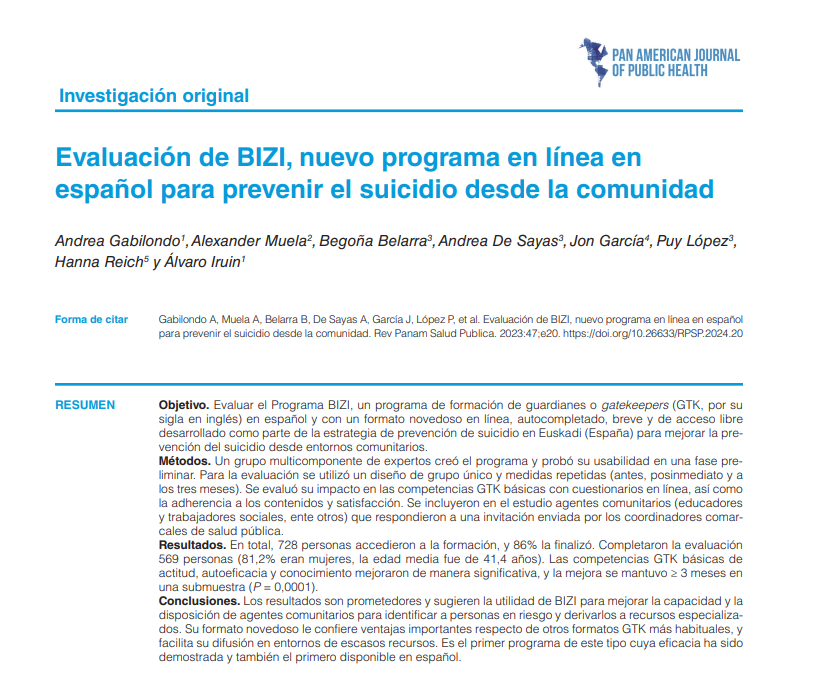
Evaluation of BIZI, a new Spanish-language online program for community- based suicide prevention

This is a pdf document for download